Fixed-Price vs. Cost-Plus Construction Contracts: Which Fits Your Project?
A set price can feel like the safest choice for a Muskoka project, but it may not answer every question about what happens when the work changes. That’s the heart of comparing fixed-price vs cost-plus construction contracts, especially when a waterfront repair or an older boathouse reveals conditions that weren’t clear at the outset.
It’s reasonable to want a clear picture of the budget and to know whether the quoted amount covers the work you have in mind. It’s just as important to understand how added work, material choices, and unforeseen conditions are documented and priced. The right structure depends on how clearly the scope can be defined, how much uncertainty remains, and how changes will be managed.
This guide explains both approaches in plain language, including what each typically covers, how costs and changes are treated, and which project conditions may make one worth discussing. Use the comparison to identify what you need clarified before planning construction or repairs on your Muskoka property.
Key Takeaways
- Compare fixed-price vs cost-plus construction contracts by looking beyond the quoted amount to how the scope and possible changes are handled.
- A fixed price can make a clearly defined project easier to budget, but it doesn’t make unforeseen conditions predictable.
- Consider how much of the work is known, how likely changes are, and what cost records you want to review before weighing the two approaches.
- For Muskoka waterfront work, access, existing structures, and material choices can shape the scope. Clear written details help keep decisions organized.
- Before agreeing to either approach, clarify what is included, how changes are approved, and what documentation you’ll receive.
Fixed-Price vs. Cost-Plus Construction Contracts: What Does Each Mean?
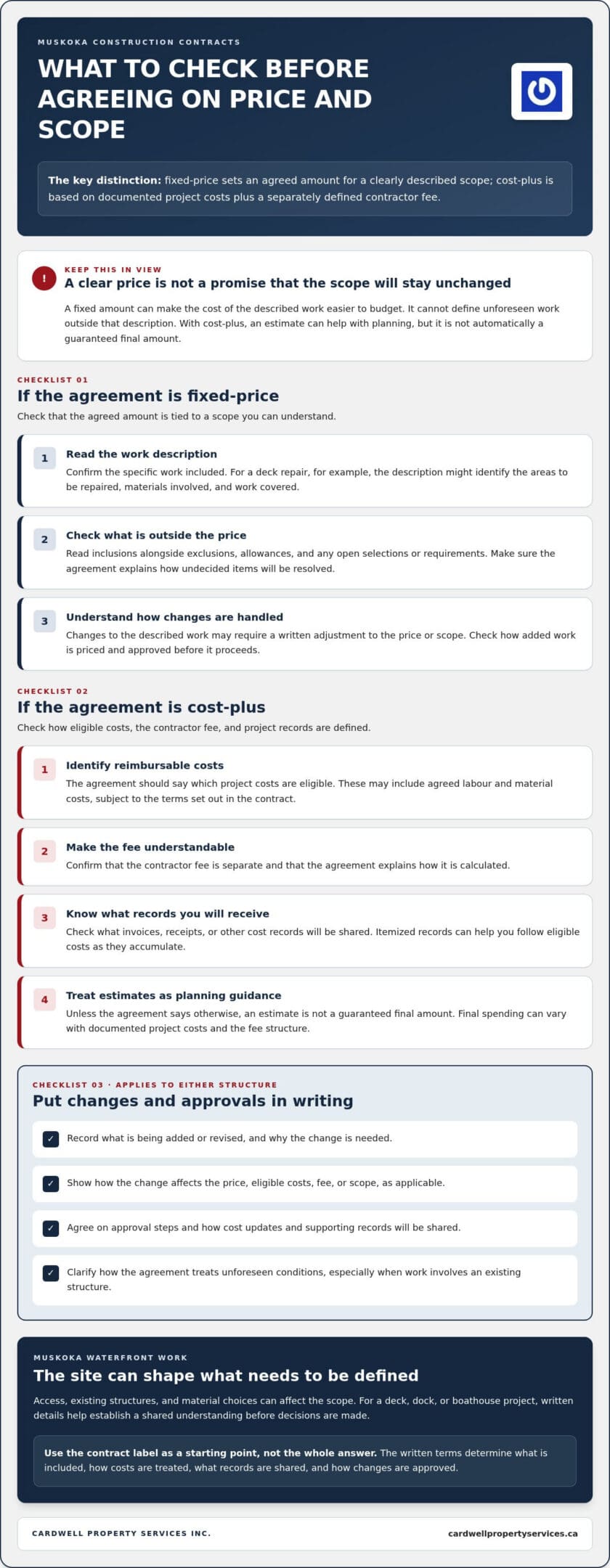
Before work begins, an owner needs to know what the agreed amount covers and what could change it. That question sits at the centre of fixed-price vs cost-plus construction contracts. A fixed-price contract sets an agreed amount for a clearly described scope of work. A cost-plus contract bases payment on documented project costs, with a separate contractor fee set out in the agreement.
Price certainty is not the same as certainty about the final scope. A fixed price can make the cost of the described work clearer, but it can’t define unforeseen work that falls outside that description. With cost-plus, the amount paid reflects eligible costs as they arise. An estimate can help with planning, but it isn’t automatically a guaranteed final amount.
The contract wording matters in both cases. It should explain what work is included and excluded, how the fee is calculated, what records are provided, and how changes are approved and priced. For a plain-language overview of how cost-plus arrangements can be structured, see Understanding Cost-Plus Contracts.
What a fixed-price construction contract sets out
A fixed-price agreement pairs a defined scope with one agreed amount for that work. For example, a deck repair description might identify the areas to be repaired, the materials involved, and the work included. The more clearly those details are written down, the easier it is to understand what the price covers. Read the inclusions alongside any exclusions and the process for approving later changes. If a selection or requirement is still undecided, make sure the agreement says how that open item will be resolved.
What a cost-plus construction contract sets out
In a cost-plus arrangement, the owner pays eligible project costs, such as agreed labour and material costs, plus a separately defined contractor fee. The agreement should identify which costs can be reimbursed, how the fee is calculated, and what invoices, receipts, or other records will be shared. These details make it easier to follow how the total develops. An estimate can guide early planning, but unless the agreement says otherwise, it shouldn’t be treated as a guaranteed final amount.
For Muskoka construction work, a written scope helps establish a shared understanding before decisions are made, especially when a project involves an existing waterfront structure. Cardwell Property Services provides construction services in Muskoka, where careful planning and clear project details support work on waterfront properties. With either contract structure, knowing how the agreement treats included work, costs, records, and changes gives owners a more useful basis for discussion. Learn more about construction work in Muskoka.
How Fixed-Price and Cost-Plus Contracts Handle Risk, Changes, and Oversight
The practical difference is not simply who carries “the risk.” Some uncertainty is about what work will be needed; other uncertainty is about how much the completed work will cost. A fixed amount can make the agreed scope easier to budget, but it can’t guarantee the scope will stay unchanged or that hidden conditions won’t arise.
Risk depends on the agreement’s exact scope and cost terms, not just the contract label. The comparison below outlines common differences, but the written terms determine how they apply to a project.
| Consideration | Fixed-price | Cost-plus |
|---|---|---|
| Budget predictability | More predictable for the work clearly included in the agreed amount; exclusions and changes can affect the total. | Final spending can vary with documented project costs and the fee structure. |
| Scope flexibility | Changes to the described work may require a written adjustment to price or scope. | Can accommodate evolving work, with additional eligible costs reflected in the amount payable. |
| Documentation | Scope, exclusions, allowances, and approved changes define what the amount covers. | Cost records help show how reimbursable expenses and the fee contribute to spending. |
| Change handling | Added work may be priced and agreed before it proceeds, as the contract provides. | Added work may be recorded as additional costs, subject to the agreement’s terms and approval steps. |
Where cost uncertainty sits in each contract
A detailed scope can reduce ambiguity, but it can’t remove uncertainty about conditions that only become apparent during work on an existing structure. Under fixed-price terms, the key question is whether the condition falls within the agreed work or calls for a change. With cost-plus, itemized records can help owners follow labour, materials, and other eligible costs as they accumulate. The Federal Acquisition Regulation on Contract Types offers a government-procurement reference point for contract structures, though it doesn’t set the terms of a private Muskoka project.
How changes and project records shape the experience
Before work changes, a written description can record what’s being added or revised, why it’s needed, and how the change affects cost or scope. A fixed-price change may use an agreed price adjustment; cost-plus terms may account for documented additional costs and the applicable fee. Neither approach removes the need for clear approval. Agree on how cost updates and supporting records will be shared, particularly if choices or site conditions evolve.
For a Muskoka deck, dock, or boathouse project, a conversation with Cardwell Property Services can help clarify the work and the questions to consider before an agreement is finalized.
Matching Construction Contracts to Project Conditions
The useful question isn’t which contract type is best in every case. It’s how well the agreement fits what’s known about the work, what may be discovered, and how you want decisions and costs tracked. Use this framework to organize a conversation about fixed-price vs cost-plus construction contracts for a Muskoka property.
- Define the scope. Can the work be described clearly, including dimensions, materials, and finished deliverables? A deck repair with the work area and materials identified may be easier to define than work on an older waterfront structure that hasn’t been fully examined.
- Identify uncertainty. Separate choices that are still open from conditions that may only become visible as work progresses. Ask how each could affect the agreed scope and the amount payable.
- Consider likely changes. Decide whether major selections can be settled before work begins or whether decisions may be needed as the project unfolds. The agreement should explain how each change is described, approved, and reflected in cost.
- Think about oversight. Decide what records and cost updates will help you follow spending and make informed decisions. A clear reporting process matters whether the amount is agreed in advance or calculated from documented costs and a fee.
Some projects have both defined and uncertain parts. An agreement can distinguish those elements only if it clearly explains which work falls under each arrangement, how costs are treated, and how changes are handled. Clear boundaries help prevent assumptions from filling gaps in the written scope.
To discuss how the work and its knowns and unknowns can be clearly described, discuss your Muskoka construction project.
When a clearly defined scope may favour fixed pricing
Work with established dimensions, selected materials, and specific deliverables can be easier to describe before construction begins. For a straightforward deck project, settle the area of work and key material choices first, then make sure the agreement identifies what the amount covers. If important selections remain open, the written scope should explain how they’ll be finalized rather than leave room for different expectations.
When evolving conditions may call for cost-plus consideration
Exploratory work or repairs to an existing waterfront structure may reveal further needs as the work progresses. That uncertainty may make cost-plus worth discussing, but it doesn’t automatically make it the better fit. The agreement still needs clear cost definitions, fee terms, and reviewable records so owners can understand how decisions affect spending over time.
Applying Contract Clarity to Muskoka Waterfront Construction
On a Muskoka waterfront property, the contract scope needs to reflect the structure and the work being planned. Access to the work area, existing conditions, and material choices can all shape what’s practical to include. For a repair, addition, deck, dock, or boathouse project, documenting what’s known and what remains undecided can help keep expectations clear as the work is discussed.
That context matters when weighing fixed-price vs cost-plus construction contracts. A defined repair may be described in detail before work begins, while work on an older structure may involve conditions that aren’t fully understood at the outset. Neither situation points automatically to one contract type. The written agreement should make clear how known work, exclusions, and later decisions will be handled.
Cardwell Property Services has been serving Muskoka for over 30 Years, with a measured approach grounded in careful craftsmanship and respect for existing properties. Clear documentation supports that thoughtful process. It gives the owner and project team a shared reference for the intended work, selected materials, and decisions still to be made. Explore Cardwell’s waterfront construction services for work connected to the structures and properties that make Muskoka distinctive.
Scope details worth recording before work begins
Before settling the scope, organize the project details in writing. Include:
- The structure and the specific work intended.
- Materials or finishes selected, along with choices still open.
- Exclusions, so work outside the agreement is clearly distinguished.
- Known conditions and areas that haven’t been assessed.
- Owner decisions that could affect the work or its scope.
For restoration, notes about the structure’s existing condition can help distinguish planned work from additional needs that may emerge. Clear scope is especially valuable when preserving an older boathouse or planning boathouse repair services.
A measured next step for a Muskoka project
Before a project discussion, gather your goals, observations about existing conditions, and any open decisions about materials or the intended work. For instance, notes about a crib dock’s known condition can help focus a conversation about crib dock repairs. Cardwell’s heritage-minded restoration work reflects a careful, steady approach, without implying that a particular contract structure suits every project.
Talk through your project with Cardwell and bring your scope questions into a practical conversation.
Set a Clear Foundation for Your Next Project
Start with a clear picture of what matters most to you: how much of the work needs to be defined before it begins, what decisions are still open, and how you want to stay informed as the project moves forward. Bringing those priorities into the conversation can help shape an agreement around the property and the work, rather than choosing a contract label first.
With fixed-price vs cost-plus construction contracts, clarity comes from making expectations visible and recording how decisions will be handled. That care is especially valuable on a Muskoka property, where construction choices can affect a structure’s character and long-term use.
Cardwell Property Services brings a meticulous, slow-and-steady approach informed by waterfront restoration experience. If you’re ready to explore your project’s needs and the questions worth discussing, talk through your Muskoka construction project with Cardwell. A thoughtful conversation is a sound next step toward work planned with care.
Frequently Asked Questions
What is the main difference between fixed-price and cost-plus construction contracts?
A fixed-price contract sets an agreed amount for a defined package of work, while a cost-plus contract calculates payment from eligible project costs and an agreed contractor fee. In fixed-price vs cost-plus construction contracts, the practical distinction is how the amount payable is established. For example, one agreement may price specified deck work as a whole, while another may track approved labour and materials as the work proceeds.
Is a fixed-price construction contract always more predictable?
No. It can make the price of clearly included work easier to anticipate, but the final amount may change if the owner requests extra work or a condition falls outside the agreed scope. For instance, a contract might cover repairs to a named section of a deck but exclude deterioration found elsewhere. Reviewing exclusions, allowances, and the process for approving extra work helps explain what the original price does and doesn’t settle.
Can a cost-plus contract include a fixed contractor fee?
Yes. A cost-plus agreement can set the contractor’s fee as a fixed amount, separate from the reimbursable project costs. That doesn’t make the total project amount fixed, since eligible costs can still vary. The agreement should spell out what the fixed fee covers, how project costs are documented, and how proposed changes are treated. This lets the owner distinguish the agreed fee from the changing cost of the work.
How are changes handled under fixed-price and cost-plus contracts?
Changes should be handled using the approval and pricing process written into the agreement. Under fixed-price terms, an added item may require an agreed adjustment to scope or price before it proceeds. Under cost-plus terms, the change may add documented costs and affect the total. For example, changing a selected finish could involve different materials. A written record of the decision, its cost treatment, and approval helps avoid relying on memory.
What costs should a cost-plus construction contract explain?
A cost-plus agreement should define which project expenses are reimbursable, how the contractor’s fee is calculated, and what records the owner will receive. It can identify how labour, materials, equipment, or subcontracted work are treated, along with any exclusions and approval requirements. These details matter for a Muskoka renovation or waterfront repair, where an owner may need to distinguish costs for the agreed work from costs tied to a later decision.
Which contract structure may suit a Muskoka waterfront repair project?
It depends on how much is known about the structure and repair before work begins. A clearly identified repair may be easier to define in advance; an older dock or boathouse may require decisions as conditions become clearer. Cardwell Property Services serves property owners in Gravenhurst, Bracebridge, Parry Sound, Huntsville, Dorset, Collingwood, Midland, Orillia, Haliburton, Port Carling, Mactier, and Barrie. Start by describing the specific work and the information available about the structure.