
Muskoka Crib Dock Repair: Preserving Foundations in 2026
Imagine hosting your family’s annual summer barbecue in Gravenhurst, only to notice a subtle, unsettling tilt as your guests gather near the water’s edge. It’s a common anxiety for many cottage owners in Bracebridge and Port Carling who realize their aging foundations are struggling against years of ice jacking and shifting lake levels. When you are considering the necessity of crib dock repair Muskoka weather and water conditions make structural integrity a top priority. You want to protect your family and your investment, but the confusion over MNRF permits and the fear of high replacement costs often lead to a stressful delay in maintenance.
We believe your dock is more than just wood and stone. It is a legacy piece of your property that deserves professional stewardship and a steady hand. This guide provides a clear roadmap to preserve your waterfront through methodical restoration rather than a total teardown. You will discover how to spot early signs of structural rot, understand the 2026 permit thresholds for cribs over 15 square metres, and learn the techniques that bring a leaning structure back to level. We will walk through the specific steps required to ensure your dock remains a safe, beautiful centrepiece of your shoreline for another twenty years or more.
Key Takeaways
- Understand why traditional timber cribs remain the preferred foundation for Muskoka’s rocky shorelines and how they endure our harsh freeze-thaw cycles.
- Identify the critical warning signs of structural rot and shifting timbers to address foundation issues before they require a total replacement.
- Navigate the specific 2026 MNRF permit thresholds and municipal requirements for Bracebridge, Gravenhurst, and Port Carling waterfronts.
- Discover how a methodical approach to crib dock repair Muskoka ensures your structure stays level and safe for the next generation of family gatherings.
- Compare the long-term value and environmental benefits of restoring a grandfathered crib dock versus the complexity of installing entirely new systems.
Why Muskoka’s Environment Challenges Traditional Crib Docks
The traditional timber crib dock is a fixture of the Muskoka landscape. For generations, these structures have served as the foundation for family memories on lakes like Rosseau and Joseph. Unlike floating or pipe docks, a crib pier construction utilizes heavy timber boxes filled with local rock ballast. This design is uniquely suited to our rugged, rocky shorelines where driving steel piles is often impractical or incredibly difficult. However, being a permanent fixture means these docks face a constant battle against the elements. Professional crib dock repair Muskoka residents rely on is rooted in this reality; the very environment that makes our region beautiful is also what works to dismantle its waterfront structures.
Maintaining these docks requires a sense of structural stewardship. It isn’t just about fixing a broken board. It’s about preserving a legacy for the next generation. The challenges are two-fold, involving both mechanical forces and biological decay. By understanding these pressures, you can better appreciate why a methodical, patient approach to restoring your dock is essential for its long-term survival and the safety of your property.
The Impact of Winter Ice Heave
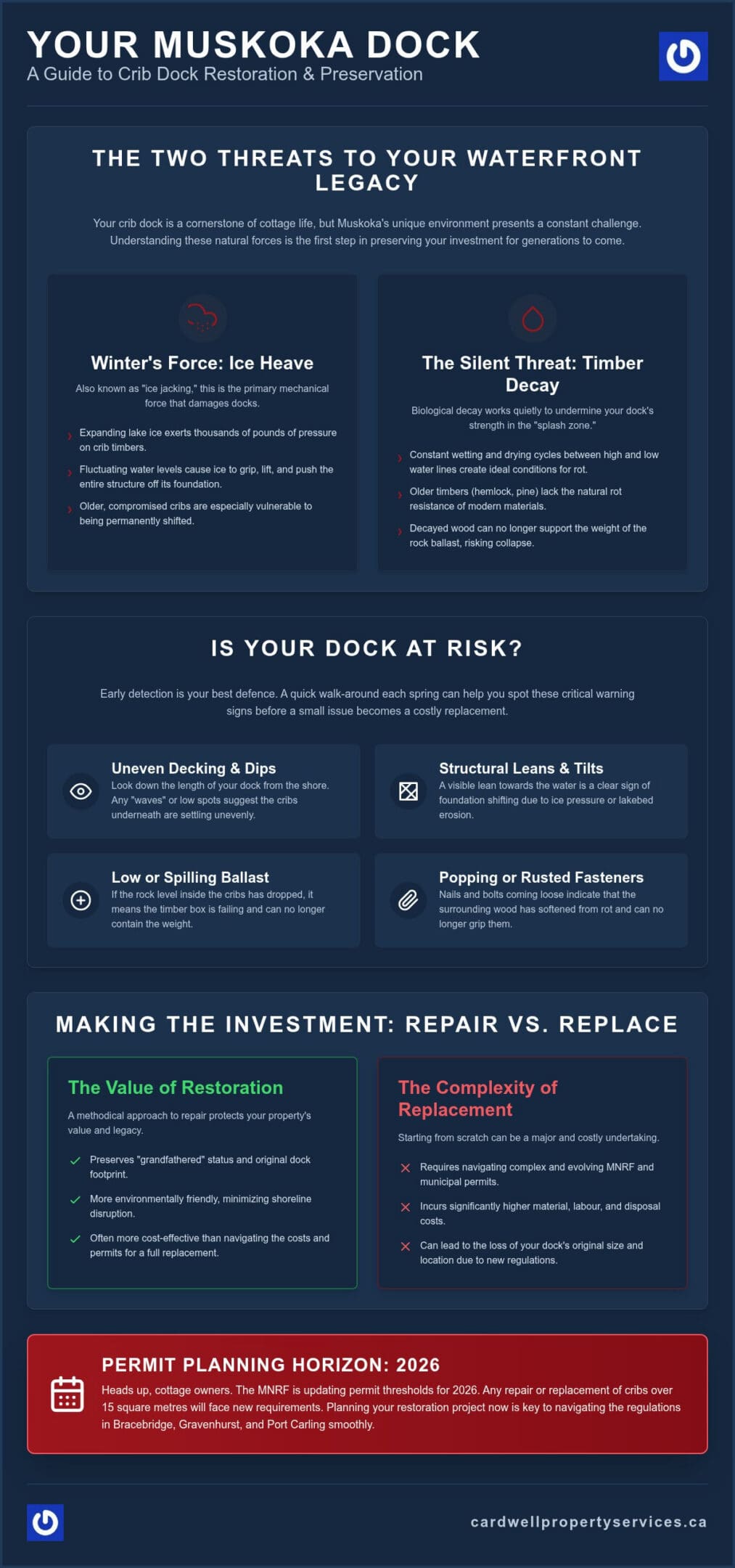
Winter in Muskoka is a powerful architect of dock damage. As lake ice expands, it can exert thousands of pounds of pressure against the sides of a crib. A phenomenon known as ice jacking occurs when the ice grips the upper timbers of the structure. As water levels fluctuate or the spring thaw begins, the ice physically lifts or pushes the crib, often shifting it off its original footprint. Older cribs are particularly vulnerable during this period, as their weight distribution may have already been compromised by years of subtle movements.
Understanding Timber Decay in the Splash Zone
While ice provides the mechanical force, biological decay works quietly in the splash zone. This is the critical area between the high and low waterlines where wood is subjected to constant moisture cycles. These cycles of wetting and drying create the perfect environment for heartwood rot. Many older Muskoka docks were built using hemlock or pine timbers, which lack the natural rot resistance found in modern western red cedar. Over time, these original timbers lose their structural integrity, making the entire dock susceptible to collapse under the weight of the rock ballast. Addressing these issues early through professional crib dock repair Muskoka services can save a structure that might otherwise be lost to the lake.
Essential Signs Your Crib Dock Requires Professional Restoration
Early detection is the most effective way to protect your waterfront investment. While a slight tilt might seem like a minor cosmetic issue, it is often the first warning of a foundation under significant stress. Ignoring these subtle shifts can lead to a total structural collapse, especially when a boathouse is resting on the cribs. Performing a methodical shoreline walk-around each spring allows you to identify issues before they become emergency repairs. If you are concerned about the stability of your structure, seeking a professional assessment for crib dock repair Muskoka can prevent a localized problem from turning into a full-scale replacement.
Your seasonal inspection should focus on three primary areas: deck alignment, ballast levels, and timber density. Use this checklist during your next visit to the cottage:
- Sightline check: Stand at the shore and look across the length of the dock. Any dips or “waves” in the decking suggest the cribs beneath are settling unevenly.
- Ballast inspection: Peer into the crib boxes. If the stone level has dropped significantly or you see large gaps where rocks have spilled out, the timber “box” is no longer contained.
- Fastener health: Look for nails or bolts that are popping out or heavily rusted. This indicates the wood is shifting or has softened to the point where it can no longer hold hardware.
Identifying Structural Leans and Shifting Foundations
A simple carpenter’s level is your best tool for a preliminary check. Place it on several sections of the deck surface; if the bubble is consistently off-centre, your foundation has likely shifted due to ice pressure or lakebed scour. It is important to distinguish between uniform seasonal settling and structural failure. Settling is typically even across the structure, whereas failure presents as a localized lean toward the water or a specific corner. If you notice your dock is pulling away from the shore road allowance or the main ramp, the cribs are no longer anchored securely. If you find these signs, it’s helpful to consult with a professional to determine the extent of the movement.
The Soft Spot Test for Timber Integrity
The “Soft Spot Test” is a practical way to assess the health of your timbers without specialized equipment. Take a flathead screwdriver to the “Critical Zone,” which involves the first two courses of logs located just above the average waterline. This area is most susceptible to the splash-zone rot discussed earlier. Press the tip of the screwdriver firmly into the wood. In a healthy timber, the tool will barely penetrate the surface. If it sinks in easily or the wood feels “punky” and fibrous, biological decay has compromised the heartwood. Once the structural core of the timber softens, it can no longer support the thousands of pounds of rock ballast inside the crib, making crib dock repair Muskoka a priority to ensure the safety of your guests.
The Methodical Process of Restoring a Sinking Crib
Restoring a foundation that has spent decades in the water requires a patient, surgical approach rather than a blunt demolition. When executing a professional crib dock repair Muskoka families can trust, we focus on preserving as much of the original, stable structure as possible. Our process begins by relieving the pressure on the foundation. We use hydraulic jacks to stabilize sinking corners, which allows us to work safely on the submerged timbers. Once the structure is secure, we employ a “lift and replace” technique. We remove the decayed timbers, particularly those in the splash zone identified earlier, and replace them with high-quality western red cedar or pressure-treated Douglas Fir. These materials are favoured for their natural density and ability to withstand the constant moisture cycles of our lakes.
A critical, often overlooked step in this process is the management of the stone ballast. As timbers rot, stones can shift or spill out, leaving the crib “light” and susceptible to ice movement. We meticulously replace or add new rock to ensure the crib is packed tight. This weight is what anchors your dock to the lakebed, providing the stability needed for large family gatherings. If you’re ready to secure your waterfront legacy, reach out to our team for a detailed structural assessment.
Leveling and Structural Realignment Techniques
Realignment is about more than just a level deck surface; it’s about ensuring the load is distributed evenly across the entire foundation. By using hydraulic systems, we can slowly bring a leaning dock back to centre without cracking the remaining healthy timbers. In some cases, we use specialized shimming techniques to account for uneven lakebed settling. Maintaining the original footprint during this process is vital. It ensures the structural integrity of the “grandfathered” foundation and keeps the project within the legal boundaries of your property’s history.
Navigating MNRF and Local Muskoka Permits
Navigating the legalities of waterfront work is a significant hurdle for many cottage owners. As of 2026, a work permit from the Ministry of Natural Resources and Forestry (MNRF) is mandatory for any repairs where the total footprint of the cribs on the lakebed exceeds 15 square metres. Even if your project falls below this threshold, you will still need a municipal building permit from your local township for structural work on cribs or stringers. Cardwell Property Services acts as your partner throughout this process, helping you navigate these regulations and ensuring your crib dock repair Muskoka project meets all provincial and local requirements. We focus on “like-for-like” restorations that respect environmental codes while protecting your property value.
Making the Investment: Repairing vs. Replacing Your Dock
Deciding whether to restore your existing foundation or invest in a full replacement is a pivotal moment for any waterfront property owner. In the Muskoka real estate market, a permanent crib dock is often viewed as a superior asset compared to temporary floating systems. Choosing crib dock repair Muskoka specialists to handle a restoration isn’t just about saving money; it’s about valuing the history of your shoreline. A professional restoration typically offers a high return on investment because it preserves the “grandfathered” footprint of your dock, which might be impossible to replicate under modern, stricter building codes.
There are times, however, when a structure is truly beyond repair. If your seasonal inspection reveals that the lakebed beneath the crib has scoured away entirely, or if the majority of the submerged timbers have lost their structural density, a full replacement may be the only safe path forward. We help our clients in Gravenhurst and Port Carling weigh these options with a focus on long-term durability rather than a quick fix. We look at the cost of targeted timber replacement versus the expense of a new boathouse construction or dock build to ensure you make an informed choice.
When Restoration is the Most Sustainable Choice
Repairing an existing crib is significantly more environmentally friendly than a new installation. By reusing the existing rock ballast, you minimize the need for heavy barge traffic and the disruption of the lakebed that comes with driving new steel piles. This targeted approach reduces material waste and preserves the natural shoreline aesthetic that defines the Muskoka experience. For those curious about how this compares to starting from scratch, our Custom Dock Builders Muskoka guide provides a deeper look at selecting a waterfront legacy that fits your specific property.
Protecting Your Legacy with Professional Craftsmanship
Your dock is the gateway to your family’s summer memories. Entrusting its care to a steady hand ensures that the repairs made today will last for another twenty years or more. Professional craftsmanship goes beyond simply replacing wood; it involves a deep understanding of the environmental pressures unique to Bracebridge and the surrounding lakes. By choosing a partner who prioritizes structural integrity and meticulous planning, you are protecting your property’s value for future generations. If you’re ready to ensure your foundation is secure for the seasons ahead, we invite you to book a professional shoreline assessment today.
Securing Your Waterfront Legacy for the Seasons Ahead
Securing your waterfront foundation is about more than just structural safety; it’s about ensuring your cottage remains a place of rest and connection for decades. We’ve explored how identifying early signs of heartwood rot and understanding the force of winter ice can save your dock from a total collapse. By choosing a methodical approach to crib dock repair Muskoka property owners can preserve their grandfathered footprints while meeting the strict 2026 MNRF permitting requirements.
At Cardwell Property Services, we bring a steady hand and decades of waterfront restoration experience to every project. We navigate the complexities of local building codes and material selection so you don’t have to. Whether your dock needs a subtle realignment or a complete timber restoration, our quiet-confidence approach ensures the work is done correctly and thoroughly. We pride ourselves on being a trusted partner for families across Gravenhurst, Bracebridge, and Port Carling.
Ready to protect your investment? Request your professional shoreline assessment from Cardwell Property Services today. Let’s work together to restore your foundation and keep your family’s legacy standing strong on the water.
Frequently Asked Questions
How long does a typical crib dock repair take in Muskoka?
A professional crib dock restoration project in Muskoka generally takes between one and two weeks to complete. This timeline depends on the complexity of the structural damage and the amount of rock ballast that needs to be moved or replaced. During a professional crib dock repair Muskoka weather and site access can influence the final schedule. We work methodically to ensure every new timber is properly seated and secured for the long term.
Do I need a permit to replace rotten logs on my dock?
Yes, structural work on a crib dock requires a municipal building permit from your local township, such as the Township of Muskoka Lakes. While simple decking replacement doesn’t usually require one, replacing rotten logs in the crib is considered structural. Additionally, if the total footprint of your cribs on the lakebed exceeds 15 square metres, a provincial work permit from the MNRF is required. We help our clients navigate these 2026 regulations to ensure compliance.
Can a leaning boathouse be leveled without a total rebuild?
In many cases, a leaning boathouse can be safely leveled using hydraulic jacks and specialized shimming techniques without requiring a total rebuild. This process involves stabilizing the foundation cribs and replacing decayed timbers in the splash zone to restore structural integrity. It’s a precise task that requires a steady hand and deep experience with Muskoka’s unique shoreline conditions. Early intervention is key to preventing the lean from causing permanent damage to the boathouse frame.
What is the best type of wood to use for crib dock repairs?
We favour western red cedar or pressure-treated Douglas Fir for crib dock repair Muskoka projects. These materials offer superior resistance to the heartwood rot common in our region’s splash zones. While many original Muskoka docks used hemlock or pine, modern cedar provides much better longevity against constant moisture. Using high-quality, corrosion-resistant fasteners alongside these timbers ensures that the restoration will withstand the harsh freeze-thaw cycles of our northern winters for decades.
How much ice damage is too much to repair?
A dock is generally considered beyond repair if the ice has completely displaced the cribs from their original footprint or if the lakebed beneath has scoured away entirely. However, most ice jacking and shifting can be corrected through professional leveling and timber replacement. If the majority of the submerged foundation remains stable, restoration is usually the most cost-effective and sustainable choice. A professional assessment is the best way to determine if your structure can be saved.
Is it better to repair my crib dock or switch to a floating dock?
For most Muskoka property owners, repairing a permanent crib dock is the better investment for long-term property value. Crib docks provide a stable foundation that floating docks cannot match, especially for structures like boathouses. Restoration also allows you to maintain grandfathered footprints that might not be approved for new builds today. While floating docks have their place, a well-maintained crib dock remains the gold standard for durability and traditional Muskoka shoreline aesthetics.