
Crib Dock Repair in Muskoka: Restoring Your Waterfront Legacy in 2026
Imagine walking down to the shoreline on a crisp May morning only to realize your dock is sitting at a slight, unsettling angle. That subtle lean after a harsh winter isn’t just a cosmetic flaw; it’s a signal that the shifting ice has finally challenged the integrity of your foundation. When considering crib dock repair Muskoka cottage owners often feel a mix of nostalgia and anxiety. You want to preserve the traditional look of your waterfront heritage, but you also need to know the structure is completely safe for your children and guests.
We believe your dock should be a place of relaxation, not a source of worry about safety or complex permit requirements. This article will help you identify early warning signs of timber rot and explain how a professional restoration can level your structure while respecting its original craftsmanship. You’ll discover how to work within the 2026 regulatory landscape, including the 15 square metre MNRF footprint rules. This knowledge provides the confidence to choose a repair path that protects your property value for the next generation.
Key Takeaways
- Learn why the traditional timber-and-rock foundation remains the most reliable choice for Muskoka’s rocky shorelines and heavy winter ice.
- Discover how to spot early signs of structural shifting and how a simple “soft spot” test can help you identify timber rot before it leads to a crisis.
- Understand the methodical process of crib dock repair Muskoka experts use to safely lift sunken structures and replace decayed logs without needing a total rebuild.
- Compare the long-term value of restoration versus replacement, including how maintaining your original footprint can often simplify the local permit process.
- Gain the peace of mind that comes with protecting your family’s waterfront legacy through craftsmanship designed to last for decades.
Understanding the Muskoka Crib Dock: A Permanent Waterfront Tradition
When you look across the shorelines of Lake Muskoka or Lake Joseph, you’ll notice that the most enduring structures share a common foundation. A crib dock is essentially a heavy, wooden framework, similar to a large crate, that’s positioned on the lakebed and filled with heavy ballast rocks. This design has been the gold standard for our region for over a century because it works with the environment rather than against it. Unlike post docks that struggle with our rugged granite lakebeds, a well-built crib uses its own weight to stay anchored. These structures are the backbone of the waterfront; they support everything from simple swimming platforms to elaborate custom docks and boathouses.
In traditional construction, we often talk about “wet” and “dry” cribs. A wet crib is the portion of the structure that stays submerged year-round, while a dry crib sits above the typical waterline. Both are essential components of Crib pier construction, providing the necessary stability to handle the weight of the decking above. Because these structures are so permanent, understanding their health is the first step in determining if you need professional crib dock repair Muskoka services to protect your investment.
The Anatomy of a Healthy Timber Crib
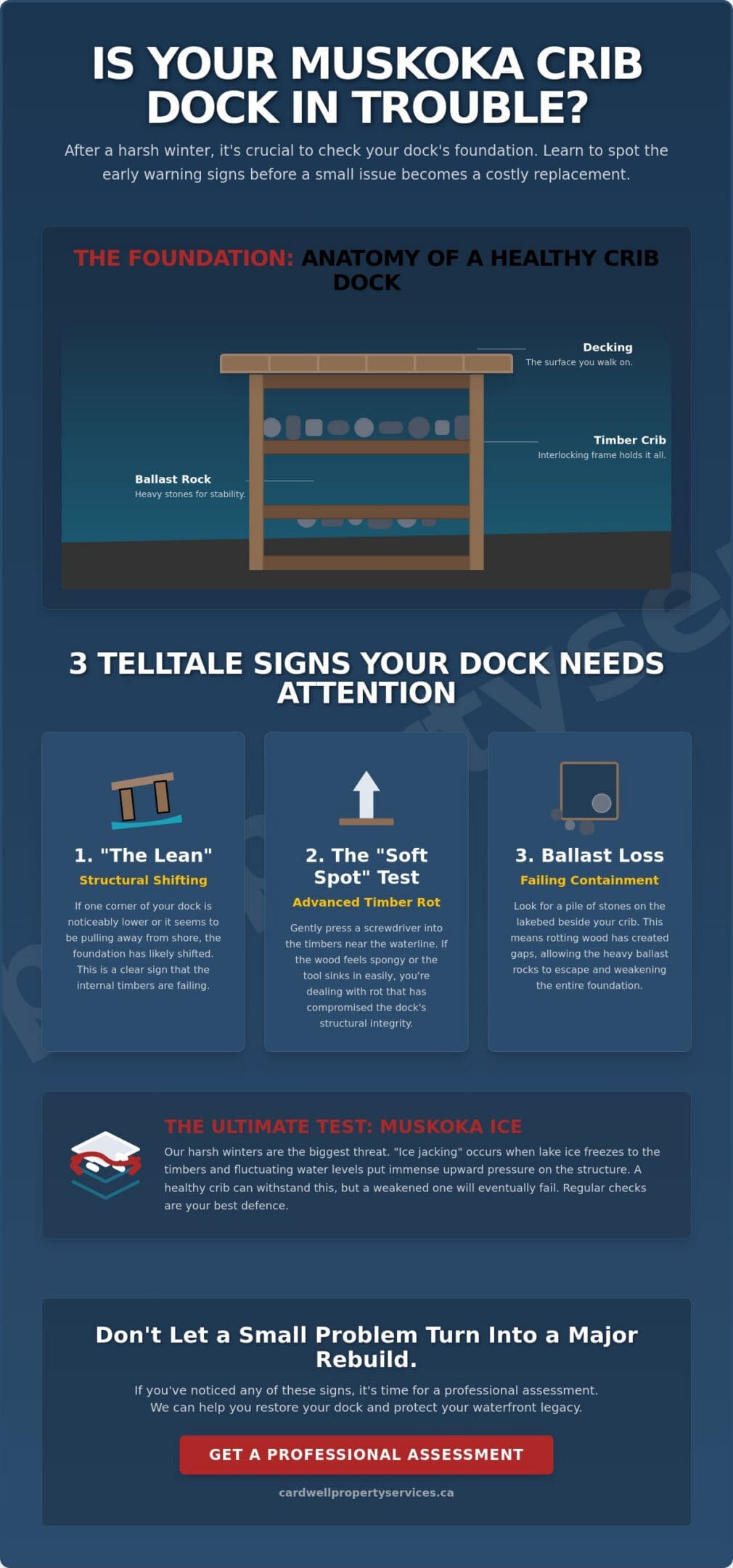
A healthy crib relies on high-quality materials and smart geometry. In Muskoka, we prefer using Douglas Fir or Cedar because these timbers stand up remarkably well to constant water exposure. The skeleton of the crib consists of “stringers,” which are the long horizontal beams, and “crossers,” which are the timbers that run perpendicular to lock everything together. This interlocking design creates a pocket for the ballast rocks. These rocks aren’t just filler; they provide the massive weight required to keep the dock from shifting when the lake gets rough. When these timbers begin to soften or the rocks settle unevenly, the entire structure can lose its level, indicating it’s time for a professional assessment.
Why Muskoka Ice is the Ultimate Test
Our winters are the primary reason why crib docks are so popular, but they’re also the biggest threat to their longevity. On large bodies of water like Lake Rosseau, a phenomenon called “ice jacking” occurs. This happens when the lake ice grips the timbers and, as the water levels fluctuate, literally tries to pull the crib out of the lakebed. In areas like Gravenhurst and Bracebridge, spring thaws cause water levels to rise and fall rapidly, putting immense pressure on the wood. A well-constructed crib is designed to “breathe” and shift slightly with these forces. However, if the timber has started to decay, the ice will eventually win. Regular maintenance and timely crib dock repair Muskoka projects ensure that your foundation remains strong enough to withstand these seasonal cycles for decades.
Signs Your Crib Dock Needs Professional Attention
Identifying a structural issue before it becomes a total loss is the key to cost-effective maintenance. While it’s tempting to think your dock is just settling into the lakebed, a noticeable tilt usually points to a deeper structural failure. This is what we call “The Lean.” If one corner of your dock sits lower than the others, or if the entire structure seems to be pulling away from the shore, the foundation has likely shifted. This shifting often happens when the internal timbers have finally succumbed to decades of pressure and moisture. Recognizing these early warning signs can be the difference between a straightforward crib dock repair Muskoka project and a complete, costly replacement.
Another reliable diagnostic is the “Soft Spot” test. You don’t need to be an engineer to perform this; a simple flat-head screwdriver will do. Gently press the tool into the timbers near the waterline. If the wood feels spongy or the screwdriver sinks in with little resistance, you’re looking at advanced timber rot. This decay compromises the “stringers” and “crossers” we discussed earlier, weakening the skeleton that holds your ballast rocks in place. When these timbers fail, you might also notice “Ballast Loss.” This occurs when the rocks inside the crib begin to settle or even escape through gaps in the rotting wood. If you see a pile of stones on the lakebed next to your crib, the structural integrity is already failing.
Finally, look at your decking. When the surface of your dock no longer sits flush with the crib, or if you notice new gaps opening up between the boards and the framing, the foundation is moving. This “Decking Disconnect” is a clear signal that the support system underneath is no longer stable. If you’re planning any significant fixes, it’s a good idea to brush up on the current shoreline work permits to ensure your restoration stays within provincial guidelines.
The “Critical Zone”: Checking the Waterline Timbers
The most vulnerable part of any dock is the area between the high and low water marks. This “Critical Zone” is constantly exposed to a cycle of wetting and drying, which is the perfect recipe for wood-destroying fungi. You can safely inspect these timbers from a kayak or by simply leaning over the edge on a calm day. Look for wood that appears darker, frayed, or “hairy.” While some silvering or cosmetic weathering is normal for Canadian cedar, deep cracks or chunks of missing wood are signs of structural decay. If the wood in this zone is failing, the weight of the dock can no longer be distributed evenly.
Shifting Foundations: Is it Ice or Rot?
Determining the cause of a shift is vital for a lasting repair. If your dock moved suddenly after a particularly cold winter, it was likely “ice jacking.” However, if the movement has been slow and steady over several years, rot is the more probable culprit. While some minor settling is normal for a brand-new dock, any movement in an older structure is a major red flag. This is especially critical if your crib supports boathouse structures, as a failing foundation can lead to roof leaks or jammed boat lifts. If you’ve noticed any of these changes this season, you might want to reach out for a professional assessment before the next winter cycle begins.
The Restoration Process: How We Save a Sinking Crib
Restoring a foundation that has spent decades underwater requires a blend of heavy machinery and delicate precision. The first step in a professional crib dock repair Muskoka project is often hydraulic lifting. We use specialized marine jacks to slowly and methodically raise the sunken portion of the structure back to its original height. This isn’t a race; it’s a careful process of weight redistribution. Once the dock is elevated, we can perform a surgical timber replacement. By supporting the weight of the ballast rocks with temporary bracing, we swap out decayed logs for fresh, structural timbers without having to dismantle the entire crib from the lakebed up.
Maintaining the integrity of the rock foundation is just as vital as the wood itself. Over time, rocks settle or shift, leaving internal voids that weaken the entire structure. We re-fill these pockets and secure the perimeter to ensure the weight remains centred. For docks sitting on the steep granite slopes common in our region, we also utilize rock pinning. This involves drilling into the Muskoka bedrock and anchoring the new timbers with steel pins, preventing the crib from sliding deeper into the lake over time. Throughout this work, we follow Fisheries and Oceans Canada’s code of practice to ensure we’re protecting the local aquatic habitat while we work.
Leveling and Structural Realignment
When a crib supports a custom boathouse, the stakes for leveling are much higher. Even a few inches of misalignment can cause doors to bind or boat lifts to malfunction. We use heavy-duty jacks and laser levels to ensure the realignment is perfect. Our team also looks at historical water level data for the Big Three lakes to ensure the new height accounts for the shifts in spring thaws and summer lows. It’s about building for the next thirty years, not just the next three.
Modernizing the Tradition: Material Upgrades
While we respect traditional methods, we often integrate modern materials to extend the life of a repair. This might mean using pressure-treated timbers for the submerged section and premium cedar for the visible portions. In some cases, we even integrate steel reinforcements into older timber frameworks to provide a level of rigidity that wood alone can’t achieve. This ensures that any crib dock repair Muskoka owners invest in today will stand up to the elements for decades. Once the foundation is solid, you can choose new decking materials, such as high-end composites or traditional wood, that complement the restored aesthetic of your waterfront.
Repairing vs. Replacing: Making the Right Investment
Deciding whether to invest in a restoration or start from scratch is the most common crossroad for cottage owners. In many cases, a professional crib dock repair Muskoka project is the smarter financial move. Restoration is often more cost-effective than a full replacement because you aren’t paying for the massive volume of new ballast rock or the high labour costs associated with a total demolition. By keeping the core structure intact and replacing only the failing timbers, you preserve the value of the materials already sitting on your lakebed. This approach allows you to focus your budget on high-quality finishes rather than just the foundation.
Reusing your existing stone isn’t just about saving money; it’s about environmental stewardship. Bringing in barges to haul away old rock and dump in new material disrupts the lakebed and the surrounding fish habitat. A methodical repair minimizes this footprint. However, there are times when a crib is truly beyond saving. If the timbers deep in the “wet” section of the crib have completely disintegrated, or if the foundation has slipped so far down a granite shelf that it’s no longer reachable, a full rebuild might be necessary. Our team looks for these “point of no return” signals during the initial assessment to ensure you aren’t spending money on a temporary fix.
Navigating Muskoka Regulations and Permits
One of the biggest hurdles for any dock project is the paperwork. In 2026, the Muskoka building permit process remains focused on footprint management. If you are performing a “like-for-like” repair on an existing structure, the path is usually much smoother than trying to build a new, larger dock. Expanding your footprint beyond 15 square metres triggers strict Ministry of Natural Resources and Forestry (MNRF) requirements. By restoring your current dock, you often stay within grandfathered rules that are much harder to secure for new builds today.
Long-Term Value and Property ROI
A permanent crib dock is more than just a place to park a boat; it’s a structural asset. Buyers in Port Carling and Lake of Bays consistently prioritize properties with stable, permanent foundations over those with temporary floating systems. A well-maintained crib offers a level of stability that floating docks simply can’t match, particularly for larger boats or social gatherings. When you plan a crib dock repair Muskoka owners can expect the structure to last for the next 25 to 30 years. You aren’t just fixing a dock; you’re securing your property’s future resale value and protecting your family legacy. If you’re ready to assess your foundation, reach out to our team for a professional consultation.
Partnering with Cardwell: Your Trusted Muskoka Dock Experts
Choosing a contractor to handle your waterfront property is about more than just finding someone with a hammer. At Cardwell, we view our work as a form of stewardship. We aren’t just performing a crib dock repair Muskoka project; we’re acting as the guardians of a structure that has likely been in your family for decades. Our deep familiarity with the unique environmental pressures of Lake of Bays, Lake Rosseau, and Lake Muskoka allows us to anticipate challenges that outsiders might miss. Whether it’s the specific way the ice pushes in a certain bay or the hidden fissures in the granite bedrock, our local experience ensures a repair that lasts.
Our process is defined by a slow and steady momentum. It begins with a comprehensive shoreline assessment where we look past the surface to evaluate the health of your submerged timbers and the stability of your ballast. We don’t believe in quick fixes that will fail in three seasons. Instead, we plan every phase meticulously, from the initial structural lift to the moment the final deck screw is driven into place. This methodical approach ensures that your waterfront remains a place of peace, and it’s why we take every crib dock repair Muskoka project so seriously. We want your foundation to be a source of security for your children and grandchildren.
A Methodical Approach to Waterfront Construction
We prioritize a sense of quiet confidence in everything we do. For a dock repair, this means arriving with a clear plan and maintaining a clean, organized job site. We understand that your cottage is a sanctuary. Respecting the delicate Muskoka shoreline is a core value for us, which is why we use locally appropriate materials that blend into the natural environment. By choosing high-quality cedar and heavy-duty fasteners, we ensure the finished project looks like a natural extension of your original cottage heritage. Our team works with a level of precision that honours the craftsmanship of the past while utilizing modern techniques for durability.
Request Your Shoreline Assessment
Securing your investment before the next winter season is the best way to prevent further structural shifting. We provide shoreline assessments for properties throughout Bracebridge, Huntsville, and Parry Sound. During our first visit, we’ll walk the property with you, explain our findings in clear language, and outline a roadmap for your restoration. There’s no pressure; just a professional conversation about the best path forward for your property. We’ll look at the timber integrity and the rock ballast to give you an honest picture of your dock’s health. Let’s discuss your dock restoration project today and ensure your family legacy remains on a solid foundation for years to come.
Protecting Your Muskoka Shoreline for the Next Generation
Your dock is the gateway to your time on the water, and keeping it stable shouldn’t be a source of constant worry. Understanding the mechanics of ice jacking and identifying rot early allows you to address structural issues before they become a crisis. By choosing a professional crib dock repair Muskoka restoration, you aren’t just fixing wood and stone; you’re preserving a grandfathered footprint and respecting the delicate balance of our local lakebeds.
At Cardwell, we bring decades of experience to every project, combining traditional timber craftsmanship with modern structural lifting techniques. We handle the complexities of local building permits and MNRF regulations so you don’t have to. Whether your dock supports a simple deck or a large boathouse, we have the specialized equipment and local knowledge to ensure it remains level and secure for decades to come.
If you’ve noticed a new lean or soft timbers this season, taking action now will protect your property value and your peace of mind. Secure your waterfront legacy with a professional dock assessment today. We look forward to helping you keep your Muskoka tradition standing strong.
Frequently Asked Questions
How much does it typically cost to repair a crib dock in Muskoka?
The cost is determined by a personalized site assessment because every shoreline is unique. Factors like water depth, the extent of timber rot, and how easily our team can reach the site all play a role. Generally, a restoration is a more affordable path than a total rebuild since you are reusing the existing rock ballast and avoiding the expense of a complete demolition.
Do I need a permit from the MNRF or the township to repair my existing dock?
Yes, most structural work requires a municipal building permit from your local township. If the total footprint of your cribs on the lakebed exceeds 15 square metres, you will also need a work permit from the Ministry of Natural Resources and Forestry. While simple decking swaps don’t usually require paperwork, any repair involving the cribs or stringers is considered a structural change.
Can you level a crib dock that has started to lean or sink on one side?
We can absolutely level a leaning dock using specialized hydraulic marine jacks. This methodical lifting process allows us to raise the sunken portion to its original height so we can replace the failed timbers underneath. Once the new, structural wood is in place and the ballast is secured, the dock returns to a stable and flush position for safe use.
How long does a professional crib dock restoration usually take to complete?
A professional crib dock repair Muskoka project typically takes between one and two weeks from start to finish. The exact timeline depends on the size of the structure and the complexity of the timber replacement. We prioritize a steady and careful pace to ensure the new foundation is perfectly aligned and the rock pockets are filled correctly for long term stability.
Is it better to repair my old timber crib or replace it with a steel pile dock?
Repairing a timber crib is often the better choice if you want to preserve a grandfathered footprint or maintain a traditional cottage aesthetic. Steel piles are durable, but they can be challenging to install on Muskoka’s uneven granite lakebeds. Restoration allows you to keep the classic look of your waterfront while significantly extending the life of the structure at a lower cost.
What is the best time of year to perform crib dock repairs in the Muskoka region?
Late spring and early autumn are the most effective times for dock repairs. During these windows, the water levels are usually more predictable and the weather is stable enough for precision lifting. Completing your repairs before the winter freeze is vital, as it ensures your dock foundation is strong enough to withstand the pressure of shifting ice and spring thaws.
How do you prevent ice from damaging my repaired dock next winter?
We prevent ice damage by ensuring your crib is perfectly level and heavily weighted with ballast. When a dock is structurally sound and properly anchored, it is much harder for “ice jacking” to grip the timbers and lift them. We also use rock pinning to secure the crib to the bedrock, which prevents the ice from shifting the entire structure out of place.
Can you repair a crib dock if it is located in a deep water or steep shoreline area?
Yes, we can perform repairs in deep water or on steep shorelines using specialized equipment designed for the Muskoka environment. These projects often require rock pinning to anchor the timbers directly into the granite shelf. This ensures the crib remains stable and won’t slide deeper into the lake, even on the rugged underwater terrain found on Lakes Rosseau and Joseph.